
For some buyers, schools are everything. For others, they're one factor among many. Neither approach is wrong—but being honest with yourself about where you fall on that spectrum will save you time, money, and frustration in your home search.

How Much Do Schools Really Matter to You?
This might sound like a simple question, but it's one that deserves some real thought. We've worked with buyers who swore schools were their top priority—until they realized the neighborhoods with the highest-rated schools didn't have the walkability, dining, or nightlife they loved. And we've worked with buyers who said schools didn't matter—until they toured a home and asked, almost as an afterthought, "So... what's the school situation here?"
The truth is, most Austin neighborhoods have access to good schools. But great schools—the ones with 9/10 and 10/10 ratings on GreatSchools—are concentrated in specific areas. And those areas might not overlap with your favorite brunch spots or the neighborhood where all your friends live.
One of the first things we ask our buyer clients is: how much do schools really factor into your decision? You can find solid schools across most of Austin, but the highest-rated campuses are in specific neighborhoods—and those neighborhoods might not have the walkable nightlife or trendy dining scene you love. That's okay. But knowing your priorities upfront saves a lot of time and helps us find the right fit faster.
— Timothy Powles, Adam Timothy GroupThis isn't about judging your priorities. It's about being intentional. If you want to live in East Austin for the culture and community, that's a great choice—just know that school options might require some creativity (more on that later). If you want your kids in a top-rated public school and that's non-negotiable, certain neighborhoods will rise to the top of your list while others fall off.
Think About Your Timeline
Here's something we see all the time: a couple who doesn't have kids yet—maybe they're not even married yet—already asking about high school ratings. They're thinking 15 to 18 years down the road before they've even closed on their first home.
We love that forward thinking. But it also opens up an important conversation about timelines and priorities.
Think about how long you're realistically going to live in this home. Are you planning to stay until your kids finish high school—20+ years? Or are you more likely to move once they're ready for school? The answer changes everything. You may want to buy something you can grow into, or you might be better off buying something that's perfect for just the next 7-10 years. Both are valid strategies, but they lead to very different homes.
— Adam Stanley, Adam Timothy GroupYour first home doesn't have to be your forever home. Some clients buy in a neighborhood they love now—close to downtown, near their favorite spots—knowing they'll move to a top school district when the time comes. Others want to plant roots early and grow into a home over the next two decades. Neither approach is wrong. What matters is being intentional about the choice.
The Good News: You Have Options
Once you've figured out how much schools matter and what your timeline looks like, here's the encouraging part: Austin offers quality educational options at virtually every price point. You don't have to buy a million-dollar home in Westlake to get access to great schools. And if your preferred neighborhood's public schools aren't highly rated, you're not out of luck.
Affordable Neighborhoods with Excellent Public Schools
Round Rock ISD is an A-rated district that ranks among the top 35 in Texas. Schools like Cactus Ranch Elementary, Canyon Creek Elementary, and Patsy Sommer Elementary consistently achieve over 90% proficiency rates—and you can find quality homes in these zones for under $500,000.
In South Austin, neighborhoods like Olympic Heights offer homes starting in the mid $300,000s with access to Baranoff Elementary (7/10 GreatSchools, top 18% in Texas) and Bowie High School (8/10 GreatSchools, top 10% in Texas, 98% graduation rate). A section of Olympic Heights feeds into the same schools as neighboring Shady Hollow—where homes often exceed $500,000—making it an exceptional value play.
North Austin offers access to schools like Deer Creek Elementary (10/10 rating) and BASIS Austin (9/10, A+ on Niche)—a public charter with no tuition—in neighborhoods priced from $350,000 to $600,000.



Private Schools: More Accessible Than You Think
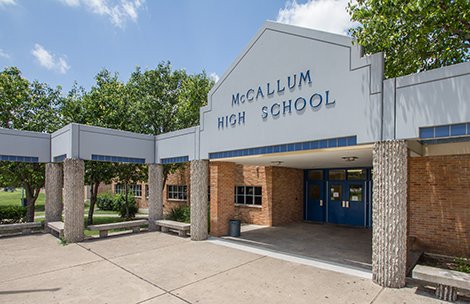
If your heart is set on a neighborhood where the public schools aren't top-rated, private education is always an option. Austin's private school landscape is remarkably distributed across the metro—not clustered only in the wealthiest areas. Options range from faith-based schools like St. Stephen's Episcopal and St. Andrew's Episcopal to classical academies like Regents School to innovative approaches at schools like Griffin School.

This means you can buy in the neighborhood you love and still access quality education—it just requires a different approach.
A New Tool: Texas Education Freedom Accounts
Here's something that changes the equation for many families. In May 2025, Governor Abbott signed Senate Bill 2, creating the Texas Education Freedom Accounts (TEFA) program—the largest day-one school choice program in American history.
Starting in the 2026-2027 school year, qualifying families can access approximately $10,000 per student annually for private school tuition, tutoring, textbooks, uniforms, transportation, and more. The program is funded with $1 billion in its first year and prioritizes students with disabilities and families earning under approximately $162,000.
What does this mean for your home search? If private school was previously out of reach financially, this program might open up neighborhoods you hadn't considered. That $10,000 annual credit could make the difference between stretching for a home in a top public school district or buying the home you actually want and using TEFA for education.
TEFA Quick Facts
- Eligibility: All Texas K-12 students who are U.S. citizens or legal residents
- Amount: Approximately $10,000 per student annually ($30,000 cap for special needs)
- Timeline: Applications open January 2026; funds available Fall 2026
- Approved Uses: Private tuition, tutoring, textbooks, uniforms, transportation, therapies
The Bottom Line: Be Intentional
Schools are important. But they're one piece of a larger puzzle that includes lifestyle, commute, budget, timeline, and what kind of life you want to build. The families we work with who are happiest in their homes are the ones who got clear on their priorities before they started touring.
Ask yourself:
- How much do schools actually factor in? Are they a hard requirement or a nice-to-have?
- What's your timeline? Are you buying for the next 7 years or the next 20?
- What are you willing to trade off? Would you sacrifice walkability for school ratings? Or vice versa?
- Are you open to private school? If so, TEFA might expand your neighborhood options significantly.
Once you have clarity on these questions, the right neighborhood often becomes obvious—and it might surprise you.
Let's Talk About Your Priorities
Ready to figure out how schools fit into your Austin home search? Let's have an honest conversation about what matters most to you.
Connect With Us