

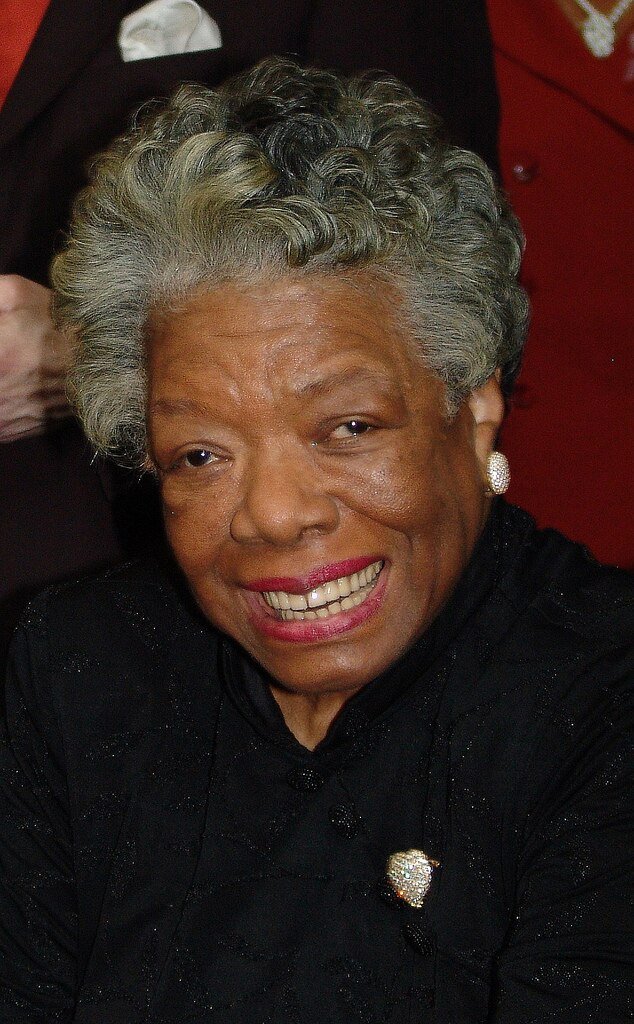
Maya Angelou transformed personal tragedy into universal triumph. From a childhood marked by trauma and silence, she became one of America's most beloved voices—a poet who spoke for the voiceless, a memoirist who gave permission for others to tell their stories, and a presence so luminous she became known simply as "Dr. Angelou."
Finding Her Voice
Born Marguerite Johnson in St. Louis in 1928, Angelou was sent to live with her grandmother in Stamps, Arkansas, at age three. At seven, she was raped by her mother's boyfriend. When her uncles killed the man after she named him, the young Maya believed her voice had caused his death. She stopped speaking for nearly six years.
In that silence, she discovered the power of words. She read voraciously—Shakespeare, Dickens, Langston Hughes—memorizing poems and plays. When she finally spoke again, she carried within her a deep understanding that language could both wound and heal.
"There is no greater agony than bearing an untold story inside you."
— Maya AngelouA Renaissance Woman
Before becoming a celebrated author, Angelou lived a thousand lives. She was a singer, dancer, actress, and the first Black female streetcar conductor in San Francisco. She lived in Cairo and Ghana, working as a journalist and educator. She was the Northern coordinator for the Southern Christian Leadership Conference, working alongside Dr. Martin Luther King Jr.
Her friend James Baldwin convinced her to write her autobiography. The result was "I Know Why the Caged Bird Sings" (1969)—a groundbreaking work that became the first nonfiction bestseller by an African American woman. Its honest portrayal of childhood trauma helped countless survivors tell their own stories.
America's Poet
In 1993, Angelou became only the second poet in history to recite an original poem at a presidential inauguration when she delivered "On the Pulse of Morning" for President Bill Clinton. The recording won a Grammy Award for Best Spoken Word Album.
For over thirty years, she taught at Wake Forest University as the Reynolds Professor of American Studies, despite never having earned a bachelor's degree. She received over fifty honorary doctorates, and her students and admirers called her simply "Dr. Angelou."
"We delight in the beauty of the butterfly, but rarely admit the changes it has gone through to achieve that beauty."
— Maya AngelouAchievements
- Presidential Medal of Freedom (2011)
- National Medal of Arts (2000)
- Three Grammy Awards for Best Spoken Word Album
- First Black woman to have a screenplay produced (Georgia, Georgia, 1972)
- Second poet to recite at a presidential inauguration (1993)
- Over 50 honorary doctoral degrees
- Featured on U.S. Quarter (2022) – first Black woman so honored
- Seven autobiographies, including "I Know Why the Caged Bird Sings"
Maya Angelou passed away on May 28, 2014, at her home in Winston-Salem, North Carolina. President Barack Obama called her "a brilliant writer, a fierce friend, and a truly phenomenal woman." Her words—about courage, about resilience, about the unshakeable human spirit—continue to rise, still singing of freedom.
"We may encounter many defeats, but we must not be defeated. That sounds goody-two-shoes, I know, but I believe that a diamond is the result of extreme pressure and time."
— Maya Angelou