

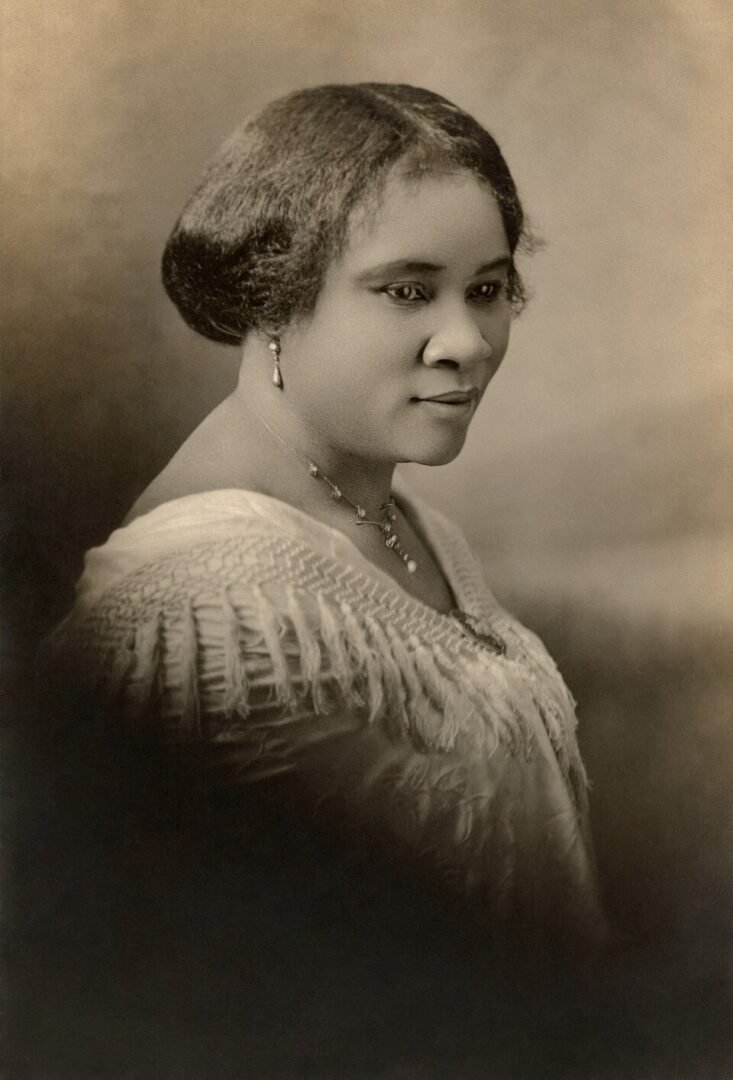
Born Sarah Breedlove on a Louisiana cotton plantation to parents who had been enslaved, Madam C.J. Walker rose from poverty to become America's first self-made female millionaire. With just $1.25 and a formula she mixed in her own kitchen, she built a beauty empire that employed thousands of Black women and redefined what was possible in America.
From the Cotton Fields to the Wash Tub
Sarah Breedlove was the first in her family born free, arriving on December 23, 1867, just two years after the Civil War ended. But freedom did not mean ease. Orphaned at seven, she moved in with her older sister and worked in the cotton fields. At fourteen, she married Moses McWilliams—partly, she later admitted, to escape her abusive brother-in-law. Widowed at twenty with a two-year-old daughter, she moved to St. Louis and spent the next eighteen years as a washerwoman, earning barely $1.50 a day.
Yet even while scrubbing clothes, Sarah dreamed of something more. At St. Paul African Methodist Episcopal Church, she found a community of educated Black women who mentored her and showed her what was possible beyond the wash tub.
"I am a woman who came from the cotton fields of the South. From there I was promoted to the washtub. From there I was promoted to the cook kitchen. And from there I promoted myself into the business of manufacturing hair goods and preparations. I have built my own factory on my own ground."
— Madam C.J. Walker, National Negro Business League Convention, 1912A Dream and $1.25
In her thirties, Sarah began losing her hair—a common problem in an era when most Americans lacked indoor plumbing and proper hygiene products. After experimenting with homemade remedies and working as a sales agent for another Black entrepreneur, she developed her own formula. In 1905, she moved to Denver with $1.25 in savings and a vision.
The following year, she married Charles Joseph Walker, an advertising man who helped her market her products. She renamed herself "Madam C.J. Walker"—adopting "Madam" from the French beauty industry pioneers—and launched "Madam Walker's Wonderful Hair Grower." She put her own photograph on every package, one of the first instances of a Black woman using her image to build a national brand.
The "Walker Method" was more than a product—it was a system: gentle shampoo, scalp massage, healing pomade, and the use of heated combs. Walker sold door to door, teaching Black women not just how to care for their hair, but how to care for themselves.
Building an Empire
By 1910, Walker had moved her headquarters to Indianapolis and built a factory for the Madam C.J. Walker Manufacturing Company. But her greatest innovation wasn't a product—it was her business model. She created a national network of licensed sales agents, almost all of them Black women, who earned healthy commissions selling Walker products.
"Open your own shop; secure prosperity and freedom," her advertisements proclaimed. At its peak, the company employed over 25,000 sales agents across the United States, Central America, and the Caribbean. Walker didn't just sell hair care—she sold economic independence.
"I got my start by giving myself a start."
— Madam C.J. WalkerIn 1916, Walker moved to Harlem and commissioned Villa Lewaro, a stunning mansion in Irvington-on-Hudson designed by the first licensed Black architect in New York State. The $250,000 estate became a gathering place for Black artists, intellectuals, and activists—a symbol that Black excellence could not be contained.
More Than a Businesswoman
Walker understood that wealth meant nothing without purpose. She gave generously to causes she believed in: $1,000 to the Indianapolis YMCA (the largest gift from a Black woman at the time), $5,000 to the NAACP's anti-lynching campaign, scholarships to Tuskegee Institute, and support for orphanages, retirement homes, and the preservation of Frederick Douglass's home.
She created the Madam C.J. Walker Benevolent Association, encouraging her agents to give back to their communities and rewarding them when they did. "I am in the business world," she told Booker T. Washington, "not for myself alone, but to do all the good I can for the uplift of my race."
Walker was also politically active. In 1917, she joined the Negro Silent Protest Parade down Fifth Avenue, protesting lynching and racial violence. She traveled to the White House to advocate for federal anti-lynching legislation and spoke out for the rights of Black soldiers serving in World War I.
Achievements
- First female self-made millionaire in America (Guinness Book of World Records)
- Built a company with 25,000+ sales agents by 1919
- Established Lelia College to train "hair culturists"
- Major donor to NAACP anti-lynching fund
- Funded scholarships at Tuskegee Institute
- Villa Lewaro listed on National Register of Historic Places
- Madame Walker Theatre Center (Indianapolis) on National Register
- Subject of Netflix series "Self Made" (2020) starring Octavia Spencer
- U.S. Postal Service stamp issued in her honor (1998)
A Legacy That Endures
Madam C.J. Walker died on May 25, 1919, at Villa Lewaro. She was fifty-one years old. At the time of her death, her estate was valued between $600,000 and $1 million—equivalent to $8 to $15 million today. Her daughter A'Lelia took over the company and used the family fortune to support the artists and writers of the Harlem Renaissance.
Walker's life proved that the American dream was not reserved for any one race or gender. From a one-room cabin in Louisiana to a mansion on the Hudson, from the wash tub to the boardroom, she showed that with vision, determination, and a willingness to help others along the way, anything was possible.
As the New York Post wrote in her obituary, Walker demonstrated that talented and generous citizens of any color "may rise to the most distinctive heights of American achievement."