

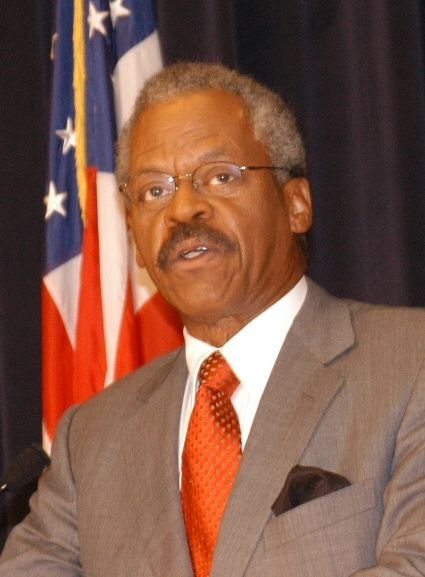
When CNN launched on June 1, 1980, it was Bernard Shaw who welcomed America to a new era of television news. As the network's first chief anchor, he became the face and voice of a revolution—24-hour news coverage that would change how the world consumed information.
For two decades, Shaw was there for the moments that mattered: Tiananmen Square, the Gulf War, presidential debates, and national tragedies. His calm, authoritative delivery became synonymous with credibility itself. He was the anchor America trusted when history was happening.
Chicago Beginnings
Bernard Shaw was born on May 22, 1940, in Chicago, Illinois. He grew up on the South Side, where his father worked as a railroad painter and his mother was a housekeeper. From an early age, Shaw was fascinated by news and current events—a passion ignited by watching Edward R. Murrow on television.
After high school, Shaw joined the U.S. Marine Corps, serving from 1959 to 1963. It was during this time that he began pursuing journalism, working at military radio stations. The discipline and precision he learned as a Marine would define his approach to journalism for the rest of his career.
"I never wanted to be famous. I wanted to be good."
— Bernard Shaw
Breaking Through
After his military service, Shaw attended the University of Illinois at Chicago while working at local radio stations. He landed his first television job at WNUS in Chicago, then moved to Washington, D.C., where he worked at WTOP and later Westinghouse Broadcasting.
In 1971, CBS News hired Shaw as a correspondent—one of the few Black journalists working at a major network at the time. He covered the White House, Capitol Hill, and major national stories. When ABC News recruited him in 1977, he became their Latin American correspondent and later a Capitol Hill correspondent.
But it was Ted Turner's audacious new venture that would make Shaw a legend.
Building CNN
When Ted Turner launched CNN in 1980, the television establishment laughed. A 24-hour news network? Who would watch? But Turner needed an anchor who could lend credibility to his experiment. He found Bernard Shaw.
Shaw took a risk leaving ABC for an unproven startup. But he believed in the concept—news when people wanted it, not just at 6 and 11. As CNN's principal anchor, he helped build the network from scratch, establishing standards and practices that would define cable news.
The gamble paid off. CNN grew from curiosity to institution, and Shaw grew with it.
Tiananmen Square
In May 1989, Shaw was in Beijing to cover a historic summit between Mikhail Gorbachev and Chinese leaders. Instead, he found himself witnessing something far more significant: the student protests in Tiananmen Square.
When the Chinese government declared martial law and began its crackdown, Shaw and his CNN crew kept broadcasting. His live reports from Beijing brought the world face-to-face with the struggle for democracy in China. The image of a lone man standing before a column of tanks became iconic—and CNN was there to show it to the world.
"Television can be a very powerful medium for truth."
— Bernard Shaw
The Gulf War
On January 16, 1991, as American bombs began falling on Baghdad, Bernard Shaw was there. Along with correspondents Peter Arnett and John Holliman, Shaw reported live from the Al-Rashid Hotel as the Gulf War began—the first war broadcast live on television.
"The skies over Baghdad have been illuminated," Shaw reported, his voice steady as explosions lit up the night. For 17 hours, the CNN team provided continuous coverage, describing what they saw and heard as history unfolded around them. It was a defining moment for both CNN and broadcast journalism.
The coverage made CNN essential viewing worldwide and cemented Shaw's reputation as one of the most trusted voices in news.
Presidential Debates
Shaw moderated presidential debates in 1988 and 1992, asking the tough questions that defined campaigns. His question to Michael Dukakis in 1988—about whether he would support the death penalty if his wife were raped and murdered—became one of the most memorable moments in debate history.
He approached every interview and debate with the same philosophy: be fair, be prepared, and never let anyone off the hook.
Legacy
Bernard Shaw retired from CNN in 2001, after 21 years as the network's anchor. He stepped away from the spotlight to spend time with his family, appearing only occasionally for special coverage.
He died on September 7, 2022, at the age of 82. Tributes poured in from across the political spectrum—a testament to his reputation for fairness and integrity in an increasingly polarized media landscape.
Bernard Shaw proved that a Black journalist could sit at the anchor desk of a major news network and command respect through sheer excellence. He didn't just report the news—he helped define what television news could be. He was calm when others panicked, prepared when others improvised, and fair when others took sides.
He was, simply, the voice America trusted.
← Back to Black History Highlights