

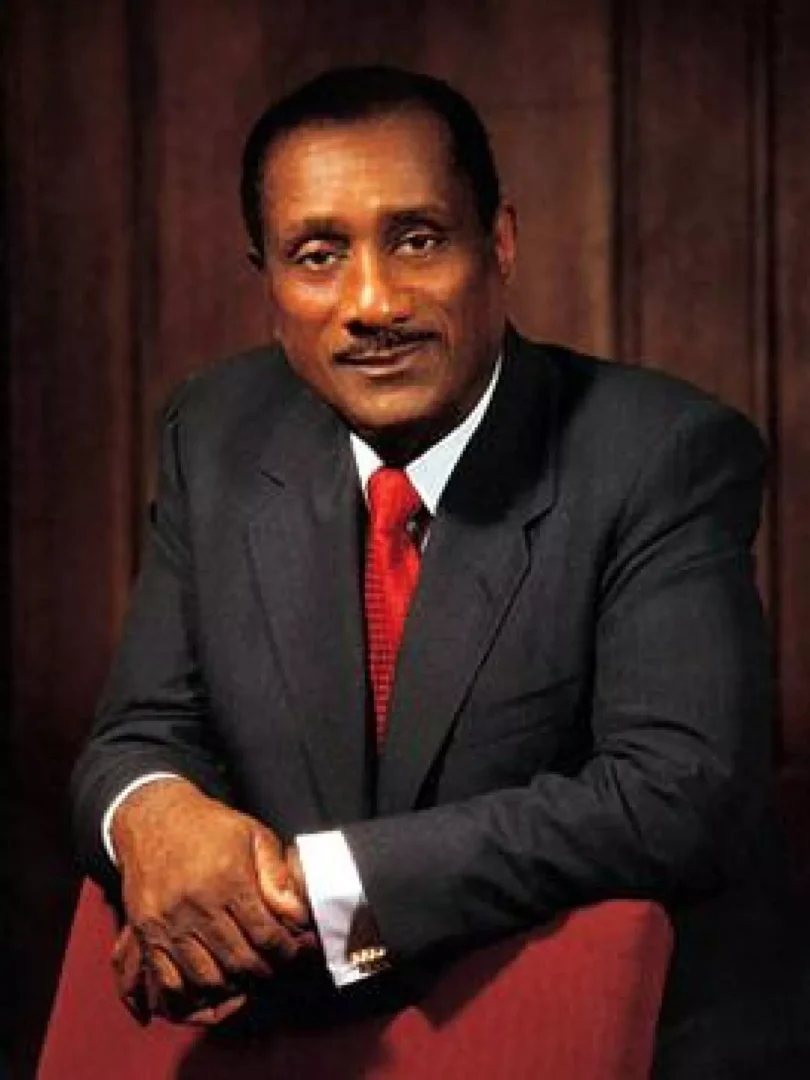
Before John H. Johnson, Black America had no mirror. The mainstream magazines of mid-century America—Life, Look, Time—showed a white world. When Black people appeared at all, it was as servants, criminals, or curiosities. Johnson changed that. He created magazines that showed Black Americans as they truly were: beautiful, successful, complex, and worthy of celebration.
With Ebony and Jet, he didn't just build a publishing empire. He built a record of Black life in America—the weddings and graduations, the celebrities and everyday heroes, the triumphs and the tragedies. For millions of Black families, his magazines were the only place they saw themselves reflected with dignity.
Arkansas to Chicago
John Harold Johnson was born in Arkansas City, Arkansas, in 1918. His father died in a sawmill accident when John was six. His mother, Gertrude, remarried and eventually moved the family to Chicago during the Great Migration, seeking better opportunities in the North.
In Chicago, young John discovered something that would shape his destiny: the power of words and images to inspire. He excelled at DuSable High School, where he edited the school newspaper and yearbook. A speech he gave at an Urban League dinner caught the attention of Harry Pace, president of Supreme Life Insurance Company, who offered him a job and a scholarship to the University of Chicago.
"Failure is a word I don't accept."
— John H. Johnson
A $500 Bet
At Supreme Life, Johnson was tasked with creating a digest of news about Black Americans for the company's employees. He noticed how eagerly people read it—how hungry they were for news about their own community. An idea took hold: what if he created a magazine that did the same thing, but for everyone?
In 1942, Johnson used his mother's furniture as collateral for a $500 loan. He used the money to mail 20,000 letters offering charter subscriptions to a new magazine called Negro Digest. Three thousand people responded. The first issue sold out its 5,000-copy print run.
The magazine grew quickly, especially after Eleanor Roosevelt contributed a column called "If I Were a Negro." By 1945, circulation had reached 100,000. Johnson had proven something important: there was a massive, underserved audience hungry for content that spoke to their lives.
Ebony
In November 1945, Johnson launched Ebony—a glossy, photo-driven magazine modeled on Life but focused entirely on Black America. The first issue featured 25,000 copies. They sold out immediately.
Ebony showed Black Americans living well—in beautiful homes, wearing elegant clothes, achieving success in every field. It covered celebrities like Lena Horne and Joe Louis, but also doctors, lawyers, teachers, and businesspeople. It was aspirational and celebratory at a time when the mainstream media offered Black Americans only stereotypes and invisibility.
By the 1960s, Ebony had become the most widely read Black publication in the world, with a circulation of over one million.
"I want to show that Black people were capable of being anything they wanted to be."
— John H. Johnson
Jet
In 1951, Johnson launched Jet, a pocket-sized weekly newsmagazine. Small enough to fit in a back pocket or purse, Jet became essential reading for Black America. It covered everything: politics, entertainment, sports, society—and it did so with speed and accessibility.
In 1955, Jet published the photographs of Emmett Till's mutilated body in his open casket—images his mother, Mamie Till-Mobley, insisted the world see. Those photographs helped galvanize the Civil Rights Movement. It was journalism as witness, as conscience, as catalyst for change.
Building an Empire
Johnson didn't stop at magazines. He built Johnson Publishing Company into a diversified media empire that included book publishing, television production, and Fashion Fair Cosmetics—one of the largest Black-owned cosmetics companies in the world. At its peak, Johnson Publishing employed over 2,600 people.
He was the first Black person to appear on the Forbes 400 list of wealthiest Americans. He received the Presidential Medal of Freedom from Bill Clinton. He was a confidant of presidents and a mentor to generations of Black journalists and entrepreneurs.
Legacy
John H. Johnson died on August 8, 2005, at age 87. By then, his publications had documented six decades of Black American life—from the final years of Jim Crow through the Civil Rights Movement, Black Power, and into a new century.
He proved that Black stories mattered, that Black audiences were valuable, and that Black entrepreneurs could compete at the highest levels. He gave Black America a mirror—and what it reflected was beautiful.
Every Black magazine, website, and media company that exists today owes something to John H. Johnson. He didn't just tell our stories. He proved that our stories were worth telling.
← Back to Black History Highlights