
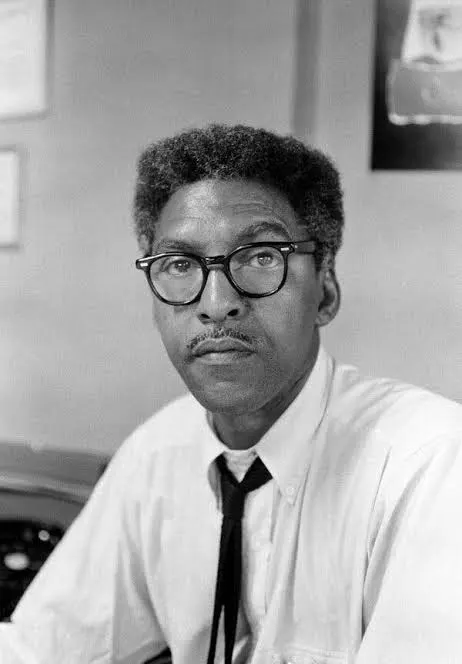
Born in West Chester, Pennsylvania and raised by his Quaker grandparents, Bayard Rustin became one of the most influential yet unsung architects of the American civil rights movement. His grandmother's faith—rooted in peace, community, and equality—shaped his lifelong commitment to nonviolent resistance.
The Man Behind the March
In 1963, Rustin organized the March on Washington for Jobs and Freedom in less than two months—the largest demonstration the nation's capital had ever seen, bringing over 250,000 people to hear Dr. King's "I Have a Dream" speech. A. Philip Randolph called him "Mr. March-on-Washington."
He was the strategist who taught Martin Luther King Jr. about Gandhi's philosophy of nonviolence, co-founded the Congress of Racial Equality (CORE), and helped establish the Southern Christian Leadership Conference (SCLC). Yet his name rarely appeared in headlines.
"We need, in every community, a group of angelic troublemakers. Our power is in our ability to make things unworkable."
— Bayard RustinThe Philosophy of Nonviolence
In 1947, Rustin participated in the first Freedom Ride, testing Supreme Court rulings against segregated interstate travel. Arrested in North Carolina, he served 30 days on a chain gang—an experience that sparked prison reform in the state. He later traveled to India to study Gandhi's movement firsthand, returning with the nickname "Mr. Nonviolence."
Rustin's mastery of nonviolent direct action made him indispensable to the movement. He trained activists, planned campaigns, and served as the intellectual bridge between Gandhian philosophy and American civil rights strategy.
A Legacy in the Shadows
As an openly gay Black man in mid-century America, Rustin often worked behind the scenes to protect the movement he loved. His sexuality was used against him by segregationists and sometimes by allies who feared it would discredit the cause. Yet he never wavered in his commitment.
In his final years, Rustin became a powerful voice for LGBTQ+ rights, declaring that gay people are "the new barometer for social change." He understood, perhaps better than anyone, that the fight for justice is indivisible.
"We are all one. And if we don't know it, we will learn it the hard way."
— Bayard RustinAchievements
- Chief organizer of the 1963 March on Washington
- Co-founder of the Congress of Racial Equality (CORE)
- Helped establish the Southern Christian Leadership Conference (SCLC)
- Participated in the first Freedom Ride (1947)
- Presidential Medal of Freedom (posthumous, 2013)
- Subject of the 2023 Netflix film "Rustin"
- Inducted into the Legacy Walk (2013)
Watch: Bayard Rustin's Story
In 2013, fifty years after the march he organized, President Barack Obama posthumously awarded Rustin the Presidential Medal of Freedom—recognizing one of America's "greatest architects of social change." His partner of ten years, Walter Naegle, accepted the honor. Bayard Rustin's life reminds us that some of history's greatest heroes worked not in the spotlight, but in service of a cause larger than themselves.