

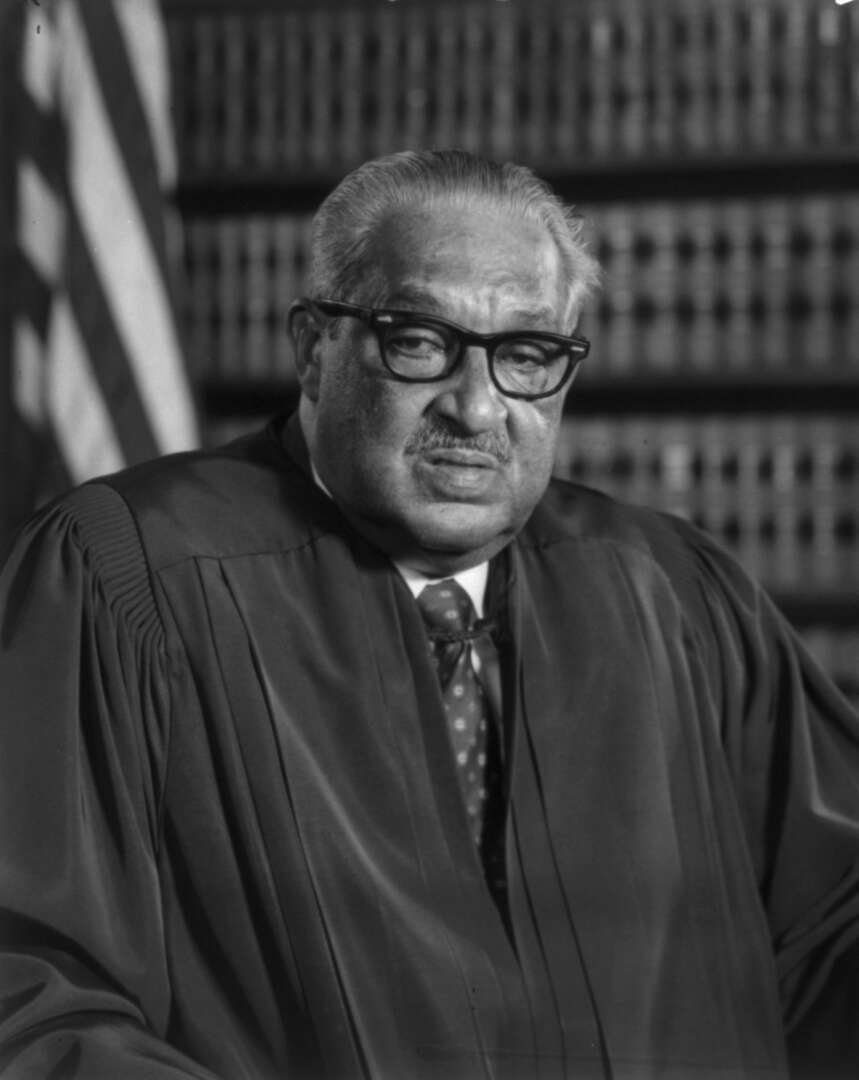
Before he became the first Black Supreme Court Justice, Thurgood Marshall changed America from the courtroom. As the NAACP's chief counsel, he argued 32 cases before the Supreme Court—and won 29 of them. His greatest victory, Brown v. Board of Education, declared school segregation unconstitutional and dismantled the legal foundation of Jim Crow. He used the law as a weapon against injustice and proved that the Constitution belonged to everyone.
Forged in Baltimore
Thoroughgood Marshall—he shortened it to Thurgood as a child because he was tired of spelling it—was born in Baltimore in 1908. His father was a railroad porter; his mother was a teacher. They raised him to stand up for himself. "My father turned me into a lawyer without knowing it," Marshall later said. "He taught me to argue, to prove my case, to make my points."
When the University of Maryland Law School rejected him because he was Black, Marshall attended Howard University instead, graduating first in his class in 1933. He never forgot the rejection—and years later, he would successfully sue the University of Maryland to integrate its law school, his first major civil rights victory.
"In recognizing the humanity of our fellow beings, we pay ourselves the highest tribute."
— Thurgood MarshallThe Lawyer Who Changed America
In 1940, Marshall became chief counsel for the NAACP Legal Defense and Educational Fund. For the next 21 years, he traveled the country—often at great personal risk—defending Black Americans and challenging segregation in the courts. He received death threats. He was nearly lynched in Tennessee. He kept going.
His strategy was methodical and brilliant. Rather than attacking segregation directly, he chipped away at its foundation, winning case after case that established the principle of equality under the law. Smith v. Allwright struck down all-white primaries. Shelley v. Kraemer banned racially restrictive housing covenants. Sweatt v. Painter ordered the integration of the University of Texas Law School.
Brown v. Board of Education
On May 17, 1954, Marshall stood before the Supreme Court to argue the most important case of his career. Brown v. Board of Education challenged the "separate but equal" doctrine that had permitted legal segregation since 1896. Marshall argued that segregation itself was inherently unequal—that it stamped Black children with "a badge of inferiority."
The Court agreed, unanimously. Chief Justice Earl Warren wrote: "In the field of public education, the doctrine of 'separate but equal' has no place." The decision was a thunderclap—the legal end of Jim Crow had begun.
"None of us got where we are solely by pulling ourselves up by our bootstraps. We got here because somebody bent down and helped us pick up our boots."
— Thurgood MarshallThe First
In 1961, President Kennedy appointed Marshall to the U.S. Court of Appeals. In 1965, President Johnson made him Solicitor General—the government's top lawyer before the Supreme Court. And in 1967, Johnson nominated him to the Supreme Court itself.
The Senate confirmed him 69-11, and Thurgood Marshall became the first African American Supreme Court Justice. He served for 24 years, consistently voting to protect civil rights, expand free speech, and limit the death penalty. He was the liberal conscience of the Court.
When he retired in 1991, a reporter asked how he wanted to be remembered. "That he did what he could with what he had," Marshall replied.
Achievements
- First African American Supreme Court Justice (1967–1991)
- Won Brown v. Board of Education (1954)
- Won 29 of 32 cases argued before the Supreme Court
- NAACP Legal Defense Fund Chief Counsel (1940–1961)
- U.S. Solicitor General (1965–1967)
- U.S. Court of Appeals Judge (1961–1965)
- Presidential Medal of Freedom (1993, posthumous)
- Thurgood Marshall Federal Judiciary Building named in his honor
A Legacy in Law
Thurgood Marshall died on January 24, 1993, at age 84. More than 20,000 people filed past his casket as he lay in state in the Great Hall of the Supreme Court—the first time a Justice had been so honored.
His legacy is written in American law itself. The cases he argued and the opinions he wrote expanded the meaning of liberty and equality for all Americans. He proved that the Constitution could be a living document—one that grows to embrace the full promise of its words.
"A child born to a Black mother in a state like Mississippi has exactly the same rights as a white baby born to the wealthiest person in the United States," Marshall once said. "It's not true, but I challenge anyone to say it is not a goal worth working for."