
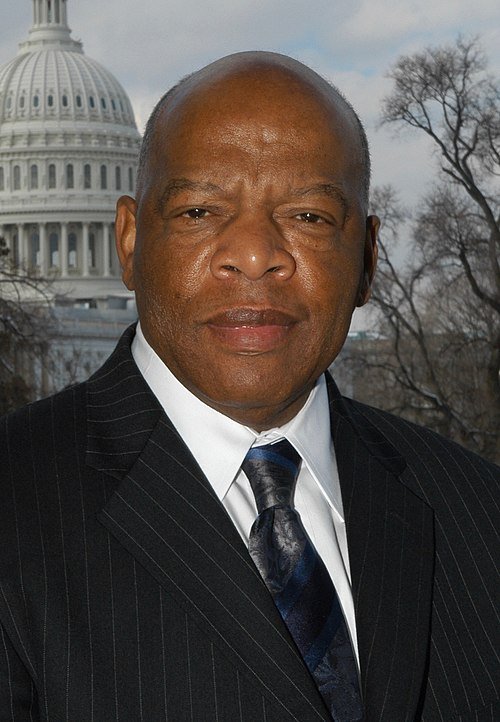
John Lewis was beaten, arrested over 40 times, and left for dead on a bridge in Selma. He never stopped marching. For more than six decades, he embodied the soul of the civil rights movement—a man who believed so deeply in nonviolent resistance that he put his body on the line, again and again, for justice. His charge to Americans was simple: "Get in good trouble, necessary trouble."
The Boy Who Preached to Chickens
John Robert Lewis was born on February 21, 1940, outside Troy, Alabama—the son of sharecroppers who picked cotton. As a boy, he wanted to be a preacher, so he practiced on the family's chickens, baptizing them and delivering sermons to his captive congregation. "They listened to me much better than some of my colleagues listen to me today in Congress," he later joked.
At 15, he heard Martin Luther King Jr. on the radio and knew he had found his calling. He wrote to Dr. King, who sent him a bus ticket to Montgomery. The meeting changed his life. Within a few years, Lewis would become one of the youngest and most fearless leaders of the civil rights movement.
"Do not get lost in a sea of despair. Be hopeful, be optimistic. Our struggle is not the struggle of a day, a week, a month, or a year, it is the struggle of a lifetime."
— John LewisFreedom Rider
In 1961, at age 21, Lewis became one of the original Freedom Riders—young activists who challenged segregation by riding interstate buses through the Deep South. In Rock Hill, South Carolina, he was beaten by an angry mob. In Montgomery, Alabama, he was struck with a crate and left unconscious in a pool of blood. He kept riding.
At 23, he became chairman of the Student Nonviolent Coordinating Committee (SNCC), making him one of the "Big Six" leaders of the civil rights movement, alongside Dr. King, Roy Wilkins, Whitney Young, A. Philip Randolph, and James Farmer.
Bloody Sunday
On March 7, 1965, John Lewis led 600 marchers across the Edmund Pettus Bridge in Selma, Alabama, demanding voting rights. They were met by state troopers who attacked them with tear gas, bullwhips, and billy clubs. Lewis's skull was fractured. The images, broadcast nationwide, shocked the conscience of America.
That day became known as "Bloody Sunday." Two weeks later, protected by federal troops, Lewis and thousands of others completed the march to Montgomery. Five months later, President Lyndon B. Johnson signed the Voting Rights Act of 1965.
"When you see something that is not right, not fair, not just, you have to speak up. You have to say something. You have to do something."
— John LewisThe Conscience of Congress
In 1986, Lewis was elected to Congress from Georgia's 5th District, representing Atlanta. He would serve for 17 consecutive terms—33 years—becoming known as "the conscience of the Congress." He never lost an election, often running unopposed.
He fought for healthcare, immigration reform, gun control, and LGBTQ+ rights. He led a sit-in on the House floor to demand action on gun violence. He boycotted presidential inaugurations when he believed democracy was threatened. He never stopped making "good trouble."
Even as his body bore the scars of countless beatings, his spirit remained unbroken. He returned to the Edmund Pettus Bridge every year to commemorate Bloody Sunday, often walking arm in arm with young activists he had inspired.
Achievements
- Original Freedom Rider (1961)
- Chairman, Student Nonviolent Coordinating Committee (1963–1966)
- Key organizer, March on Washington (1963)
- Led march on Bloody Sunday in Selma (1965)
- U.S. Representative, Georgia's 5th District (1987–2020)
- Presidential Medal of Freedom (2011)
- National Book Award for "March" graphic novel trilogy
- Arrested 45 times for civil rights activism
The Final March
John Lewis was diagnosed with Stage IV pancreatic cancer in December 2019. Even as he underwent treatment, he continued to work and speak out. In June 2020, just weeks before his death, he visited Black Lives Matter Plaza in Washington, D.C., to show solidarity with a new generation of protesters.
He died on July 17, 2020. His body crossed the Edmund Pettus Bridge one final time, carried by a horse-drawn caisson as thousands lined the route.
In an essay published the day of his funeral, Lewis left America with a final charge: "Though I may not be here with you, I urge you to answer the highest calling of your heart and stand up for what you truly believe... When historians pick up their pens to write the story of the 21st century, let them say that it was your generation who laid down the heavy burdens of hate at last."