

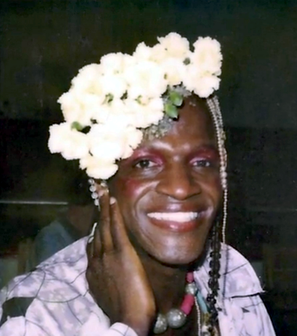
When asked what the "P" in her name stood for, Marsha P. Johnson would simply say, "Pay it no mind." It was her mantra—a shield against a world that demanded explanations she never owed anyone. That phrase would come to define not just her identity, but her revolutionary spirit.
The Front Lines of Liberation
In the early morning hours of June 28, 1969, police raided the Stonewall Inn in New York City's Greenwich Village—a routine occurrence that targeted LGBTQ+ communities. But this time was different. This time, the community fought back. And Marsha P. Johnson was there at the front lines.
Accounts of that night vary, but Marsha's presence in the uprising is undisputed. Whether she threw the first bottle or the first punch matters less than what she did in the years that followed—turning a moment of resistance into a lifetime of advocacy.
STAR Power
In 1970, alongside her close friend Sylvia Rivera, Marsha co-founded STAR—Street Transvestite Action Revolutionaries. Operating out of a cramped apartment in the East Village, STAR House became a refuge for homeless transgender youth and drag queens who had nowhere else to go. Marsha and Sylvia gave what little they had, often going hungry themselves to feed the young people in their care.
This was mutual aid before the term became fashionable—radical love in action, practiced by those who had the least but gave the most.
"I was no one, nobody, from Nowheresville, until I became a drag queen."
— Marsha P. Johnson
A Life of Visibility
Born Malcolm Michaels Jr. in Elizabeth, New Jersey, Marsha arrived in New York City in 1966 with $15 and a bag of clothes. She found her community in the streets, the piers, and the clubs of Greenwich Village. She became a fixture at the legendary Hot Peaches theater troupe and a muse to Andy Warhol, who photographed her for his "Ladies and Gentlemen" series.
But Marsha's visibility came at a cost. She faced violence, poverty, and periods of mental health crises throughout her life. Yet she continued to show up—at Pride marches, at ACT UP demonstrations during the AIDS crisis, wherever her community needed her.
An Unfinished Story
On July 6, 1992, Marsha's body was found in the Hudson River. Her death was initially ruled a suicide, a conclusion that her friends and community immediately rejected. After years of advocacy, the case was reopened in 2012 and reclassified as undetermined. The truth of what happened to Marsha P. Johnson remains unknown.
But what we do know is this: Marsha P. Johnson helped ignite a movement that continues to this day. The rights that LGBTQ+ Americans now enjoy—the right to marry, to serve openly in the military, to exist without shame—trace back to activists like Marsha who refused to accept invisibility.
Legacy
Today, Marsha P. Johnson is recognized as a founding figure of the modern LGBTQ+ rights movement. In 2019, New York City announced that a monument to Marsha and Sylvia Rivera would be erected near the Stonewall Inn—the first public monuments in the world dedicated to transgender people. The East River State Park in Brooklyn was renamed Marsha P. Johnson State Park in her honor.
Her life reminds us that liberation is never given—it is taken, by those brave enough to demand it. And when the world asks who you are or what you stand for, sometimes the most revolutionary answer is simply: pay it no mind.
← Back to Black History Highlights