

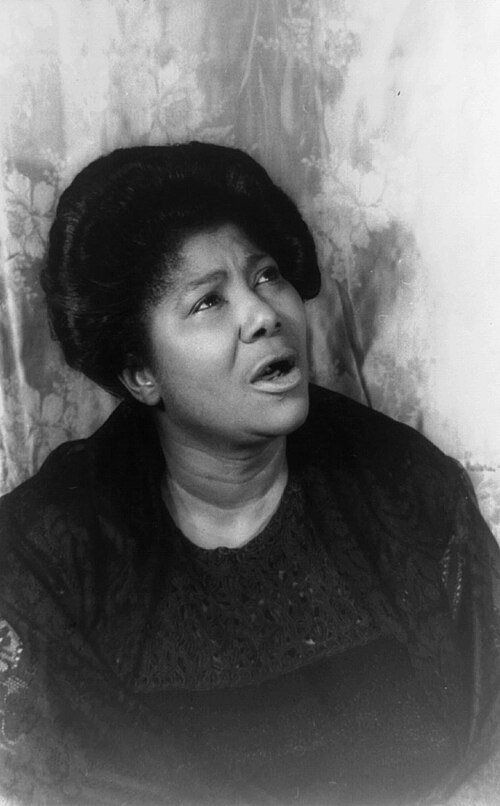
There are voices, and then there is Mahalia Jackson. Hers was a voice that could shake the walls of a church, bring a president to tears, and lift an entire movement toward freedom. She was the greatest gospel singer who ever lived—and she knew exactly what that voice was for. She refused to sing secular music, turned down nightclubs and jazz labels, and devoted her extraordinary gift to the glory of God and the fight for justice. In doing so, she became one of the most important cultural figures of the twentieth century.
New Orleans Roots
Mahalia Jackson was born on October 26, 1911, in a shotgun house in New Orleans's impoverished Black Pearl neighborhood. Her father was a longshoreman, barber, and preacher. Her mother died when Mahalia was five. Raised by aunts in a strict religious household, she grew up singing in the Mount Moriah Baptist Church—and sneaking listens to the blues records of Bessie Smith and Ma Rainey that drifted from neighboring houses.
That fusion—the sanctified power of the church and the raw emotion of the blues—would become her signature. At 16, she moved to Chicago with little more than her voice and her faith. She joined the Greater Salem Baptist Church choir and began singing at funerals, revivals, and church conventions across the South Side.
"I sing God's music because it makes me feel free. It gives me hope. With the blues, when you finish, you still have the blues."
— Mahalia JacksonThe Voice That Changed Everything
In 1947, Mahalia recorded "Move On Up a Little Higher" for Apollo Records. It sold over two million copies—an almost unheard-of number for gospel music—and made her an overnight sensation. Her contralto voice, with its incredible range and emotional depth, transcended genre. She could whisper a hymn into your soul or send a shout rolling through an arena like thunder.
She became the first gospel artist to sing at Carnegie Hall, the first to perform on The Ed Sullivan Show, and the first to have a gospel program on network television. Record executives begged her to sing pop, jazz, blues—anything commercial. She refused every time. "I was born to sing gospel," she said, "and no amount of money could make me change."
Columbia Records signed her anyway, on her terms. Her albums sold millions worldwide. She sang for royalty in Europe, performed before packed houses in Japan and India, and became the most famous gospel artist on the planet.
The Sound of the Movement
Mahalia Jackson didn't just sing about freedom—she marched for it. She was a close friend and confidante of Dr. Martin Luther King Jr., and her voice became the unofficial soundtrack of the civil rights movement. She sang at rallies, marches, and fundraisers across the South, often at great personal risk. Her home in Chicago was shot at. She received death threats. She kept singing.
On August 28, 1963, Mahalia Jackson stood on the steps of the Lincoln Memorial before 250,000 people at the March on Washington. She sang just before Dr. King took the podium. And in a moment that changed history, as King read from his prepared remarks, Mahalia called out from behind him: "Tell them about the dream, Martin!" King pushed his notes aside—and delivered the improvised crescendo that became the most famous speech in American history.
"Do you know the meaning of this? This is the beginning of a new day."
— Mahalia Jackson, at the March on Washington, 1963Mahalia Jackson — The Queen of Gospel
A Friend to Kings
Mahalia sang at the inaugurations of Presidents Eisenhower and Kennedy. She sang at Dr. King's funeral in 1968, performing "Take My Hand, Precious Lord"—his favorite hymn—through her tears. World leaders sought her company. Duke Ellington called her "the single most important person in the history of gospel music." But she never lost touch with who she was: a church girl from New Orleans who believed that God had given her a voice for a reason.
She used her fame to support the movement financially, often quietly. She housed civil rights workers in her home. She invested in Black businesses on the South Side of Chicago. She was as generous with her resources as she was with her voice.
Achievements
- Greatest gospel singer in history — "The Queen of Gospel"
- "Move On Up a Little Higher" sold over 2 million copies (1947)
- First gospel artist to perform at Carnegie Hall
- Sang at the March on Washington before Dr. King's "I Have a Dream" speech (1963)
- Sang at the inaugurations of Presidents Eisenhower and Kennedy
- Grammy Lifetime Achievement Award (1972)
- First gospel artist featured on The Ed Sullivan Show
- Presidential Medal of Freedom (posthumous)
- Inducted into the Rock and Roll Hall of Fame (Early Influence, 1997)
- U.S. Postal Service commemorative stamp issued in her honor
Going Home
Mahalia Jackson died on January 27, 1972, at age 60, in Evergreen Park, Illinois. Over 50,000 people filed past her casket in Chicago. Aretha Franklin sang at her funeral. She was buried in Providence Memorial Park in Metairie, Louisiana—not far from the New Orleans neighborhood where she was born.
Her influence is immeasurable. Every gospel singer who followed walks in her footsteps. Every artist who uses their platform for justice follows her example. She proved that sacred music could move the world—that a voice lifted in praise could also be a voice raised in protest. She sang, and the world listened. She sang, and the world changed.