

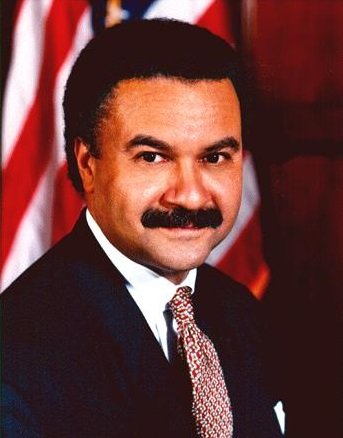
Ron Brown didn't just break barriers—he shattered them, then held the door open for everyone behind him. As the first African American Chairman of a major political party and the first African American Secretary of Commerce, he transformed American politics and global trade. He was a master strategist, a tireless advocate for inclusion, and a bridge builder who believed that economic opportunity was the truest form of empowerment.
A Harlem Education
Ronald Harmon Brown was born in Washington, D.C., in 1941, but grew up in Harlem, where his father managed the storied Hotel Theresa—known as "the Waldorf of Harlem." The hotel was a gathering place for the Black elite, and young Ron grew up surrounded by figures like Joe Louis, Duke Ellington, and Adam Clayton Powell Jr. It was an education in excellence, ambition, and the art of connecting people.
Ron attended Middlebury College in Vermont, where he became the first Black member of Sigma Phi Epsilon fraternity—integrating the entire national organization. After serving as an Army officer in Germany and Korea, he earned his law degree from St. John's University.
"The only justification for ever looking down on someone is to pick them up."
— Ron BrownThe Power Broker
Brown joined the National Urban League and rose to become a top lobbyist and political strategist. His ability to work across racial lines and connect disparate groups caught the attention of Democratic Party leaders. In 1980, he managed Ted Kennedy's convention campaign. By the late 1980s, he had become one of the most influential political operatives in Washington.
In 1989, he made history as the first African American elected Chairman of the Democratic National Committee. Skeptics said a Black man couldn't lead a major party. Brown proved them wrong spectacularly—engineering Bill Clinton's 1992 presidential victory by rebuilding the party's coalition and bringing in new donors, new energy, and new voters.
Secretary of Commerce
President Clinton rewarded Brown's brilliance by appointing him Secretary of Commerce in 1993. Brown transformed a department that many considered a backwater into a powerhouse of American economic diplomacy. He led trade missions around the world—to China, India, South Africa, the Middle East—opening markets for American businesses and insisting that minority-owned firms had a seat at the table.
Under Brown's leadership, American exports surged. He championed the idea that commerce could be a tool for peace and opportunity, not just profit. He was particularly passionate about bringing economic development to communities that had been left behind—in Appalachia, in the inner cities, and in developing nations.
"We must all hang together, or assuredly we shall all hang separately."
— A favorite quote of Ron Brown's, originally by Benjamin FranklinA Life Cut Short
On April 3, 1996, Ron Brown was leading a trade mission to the Balkans, working to bring economic recovery to war-torn Bosnia and Croatia. His Air Force plane crashed into a mountainside near Dubrovnik, Croatia, in a violent rainstorm. All 35 people aboard were killed. Ron Brown was 54 years old.
President Clinton wept openly at the news. "Ron Brown walked and worked and lived and breathed for people, whether it was a little child in the inner city or an American executive trying to close a deal in a distant part of the world," Clinton said. "He was the best I ever saw."
Achievements
- First African American Chairman of the Democratic National Committee (1989)
- First African American U.S. Secretary of Commerce (1993–1996)
- Architect of Bill Clinton's 1992 presidential victory
- Led historic trade missions to China, India, South Africa, and the Middle East
- First Black member of Sigma Phi Epsilon, integrating the national fraternity
- U.S. Army veteran
- Ron Brown Award for Corporate Leadership established in his honor
- U.S. Department of Commerce headquarters named the Ronald H. Brown Building
Ron Brown's life was a testament to what happens when talent meets determination and doors begin to open. He didn't just enter rooms where no Black man had stood before—he transformed those rooms. He proved that diversity wasn't just morally right but economically essential. And though his life was tragically short, the path he blazed remains wide open for those who follow.