
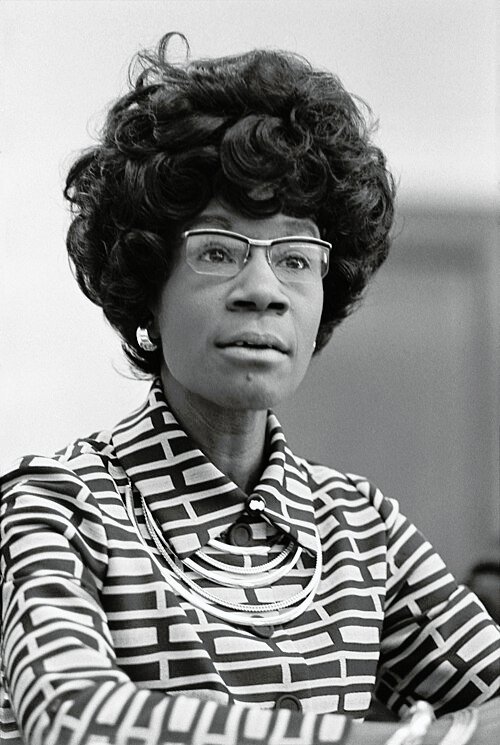
Shirley Anita Chisholm shattered ceilings that many believed could never be broken. Born in Brooklyn to immigrant parents from Barbados and Guyana, she became the first Black woman elected to the United States Congress in 1968 and the first woman and African American to seek a major party's presidential nomination in 1972. Her campaign slogan—"Unbought and Unbossed"—became a declaration of independence for a new generation of political leaders.
A Foundation in Barbados
When Shirley was five years old, her parents sent her and her sisters to live with their grandmother in Barbados, where she received a rigorous British-style education in a one-room schoolhouse. Years later, she credited this foundation for her eloquence and clarity: "If I speak and write easily now, that early education is the main reason." Her grandmother instilled in her an unshakeable sense of self-worth. "Granny gave me strength, dignity, and love," Chisholm recalled. "I learned from an early age that I was somebody."
Returning to Brooklyn at age eleven, she excelled at Girls' High School and graduated cum laude from Brooklyn College, where she won prizes for debate and joined the Harriet Tubman Society, advocating for integration and the inclusion of African American history in the curriculum.
"If they don't give you a seat at the table, bring a folding chair."
— Shirley ChisholmFighting Shirley Chisholm
After earning her master's degree from Columbia University, Chisholm became an expert in early childhood education. But politics called. In 1964, she won a seat in the New York State Assembly, overcoming resistance from men who questioned whether a woman belonged in politics. Her response was characteristic: she appealed directly to women voters and won decisively.
Four years later, she ran for Congress in Brooklyn's newly redrawn 12th district. Her campaign sound truck announced: "Ladies and gentlemen, this is fighting Shirley Chisholm coming through." She defeated civil rights leader James Farmer by a two-to-one margin, becoming the first Black woman in Congress.
When Speaker of the House assigned her to the Agriculture Committee—irrelevant to her urban constituents—she refused to accept it quietly. She lobbied successfully for reassignment to the Education and Labor Committee, where she could actually serve her community. There, she played a critical role in creating the Special Supplemental Nutrition Program for Women, Infants and Children (WIC), which continues to help millions of families today.
The 1972 Presidential Campaign
On January 25, 1972, Chisholm announced her candidacy for President of the United States—the first woman to seek the Democratic nomination and the first African American to seek a major party's nomination. She called for a "bloodless revolution" in American politics.
"I am not the candidate of black America, although I am black and proud," she declared. "I am not the candidate of the women's movement of this country, although I am a woman and equally proud of that. I am the candidate of the people."
Her campaign was underfunded, raising only $300,000. The Democratic establishment ignored her, and even some Black male colleagues provided little support. "When I ran for the Congress, when I ran for president, I met more discrimination as a woman than for being black," she later reflected. "Men are men."
"I ran because somebody had to do it first. I ran because most people thought the country was not ready for a Black candidate, not ready for a woman candidate. Someday—it was time in 1972 to make that someday come."
— Shirley ChisholmShe won 152 delegate votes at the Democratic National Convention—not enough to win, but enough to prove that a Black woman could command national attention and support. She became the first woman to appear in a United States presidential debate.
Building Coalitions
Chisholm understood that progress required unlikely alliances. When segregationist George Wallace was shot during the 1972 campaign, she visited him in the hospital—a controversial decision that shocked many supporters. Years later, when she needed Southern votes to pass legislation extending minimum wage to domestic workers, Wallace helped deliver them.
In 1971, she co-founded both the Congressional Black Caucus and the National Women's Political Caucus, understanding that the fights for racial and gender equality were inseparable. She advocated for the Equal Rights Amendment, opposed the Vietnam War, and fought for the rights of domestic workers, the poor, and Native Americans.
Achievements
- First Black woman elected to Congress (1968)
- First woman and African American to seek major party presidential nomination (1972)
- First woman to appear in a U.S. presidential debate (1972)
- Co-founder of the Congressional Black Caucus (1971)
- Co-founder of the National Women's Political Caucus (1971)
- Instrumental in creating the WIC nutrition program
- Presidential Medal of Freedom (posthumous, 2015)
- Congressional Gold Medal (posthumous, 2024)
- Inducted into the National Women's Hall of Fame (1993)
- Shirley Chisholm Forever Stamp issued (2014)
Legacy of Leadership
After seven terms in Congress, Chisholm retired in 1983 and taught at Mount Holyoke College and Spelman College, shaping a new generation of leaders. "If you don't accept others who are different," she told students, "it means nothing that you've learned calculus."
Her influence echoes through every woman and person of color who has since sought the nation's highest offices. Kamala Harris launched her 2020 presidential campaign 47 years to the day after Chisholm's announcement, using similar typography and colors in tribute. Barack Obama posthumously awarded her the Presidential Medal of Freedom in 2015, and in 2024, she received the Congressional Gold Medal.
Shirley Chisholm died on January 1, 2005, in Florida. The inscription on her vault in Buffalo reads simply: "Unbought and Unbossed." At her funeral, the minister said she brought about change because "she showed up, she stood up and she spoke up." Her life proved that the barriers we think are permanent are simply waiting for someone brave enough to break them.