

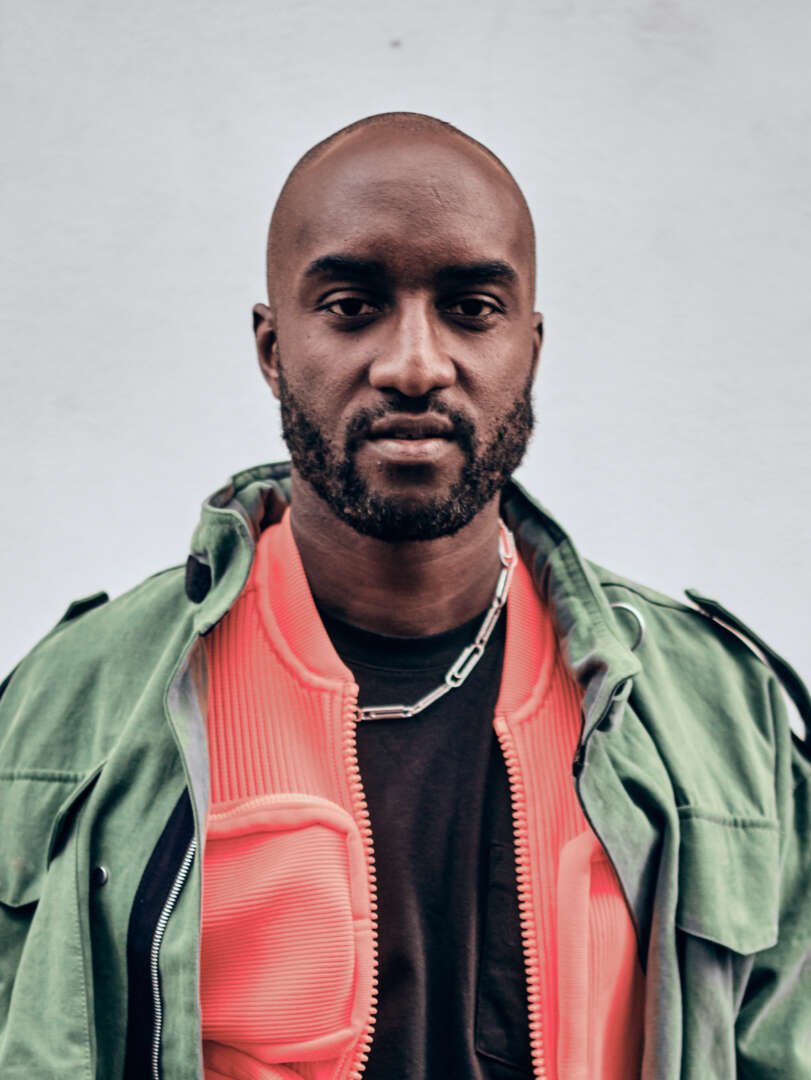
He put quotation marks around everything—"SHOELACES" on shoelaces, "AIR" on Air Jordans, "SCULPTURE" on an Ikea bag. It seemed like a joke until you realized it was a revolution. Virgil Abloh didn't just design clothes. He redesigned how we think about design itself.
In a fashion world that had always kept its gates locked tight, he walked in through the front door—a Black kid from Rockford, Illinois, who became the artistic director of Louis Vuitton menswear. And he held that door open for everyone behind him.
The Outsider
Virgil Abloh was born in 1980 to Ghanaian immigrant parents. His mother was a seamstress. His father managed a paint company. They settled in Rockford, Illinois, a working-class city far from the fashion capitals of the world.
He didn't go to fashion school. He studied civil engineering at the University of Wisconsin-Madison, then earned a master's degree in architecture from the Illinois Institute of Technology. He came to fashion sideways, which is exactly why he could see it differently.
His education taught him to think in systems, to understand how things are constructed. But his real education came from the streets—from skateboarding and hip-hop, from DJ culture and screen printing, from the creative energy of young Black and Brown kids making something out of nothing.
"I'm not trying to be the next anyone. I'm trying to be the first me."
— Virgil Abloh
The Kanye Connection
In 2002, Abloh met Kanye West at a screen-printing shop in Chicago. It was the beginning of a creative partnership that would reshape culture. They interned together at Fendi in Rome. They collaborated on album artwork, stage designs, and the creative direction of Kanye's brand.
When Kanye crashed the fashion establishment with his Yeezy line, Virgil was right there with him—learning, observing, preparing for his own moment. They proved that hip-hop kids belonged in the front row, not just in the audience.
Off-White
In 2013, Abloh launched Off-White, his own fashion label based in Milan. The name itself was a statement—not black, not white, but something in between. The brand became famous for its signature touches: diagonal stripes, zip ties, industrial belts, and those quotation marks that turned ordinary objects into art objects.
A plain white t-shirt became "T-SHIRT." Sneakers became cultural artifacts. Off-White was streetwear elevated to high fashion, or high fashion dragged down to the streets—depending on who you asked. Either way, it worked. The brand became a phenomenon, coveted by celebrities and kids in line at Supreme alike.
"The one thing I've never been is precious. That's why I can do so much, because I treat everything as a rough draft."
— Virgil Abloh
Louis Vuitton
In March 2018, LVMH announced that Virgil Abloh would become the artistic director of Louis Vuitton's menswear collection. He was the first Black person to ever hold that position at the French luxury house.
At his first show, Abloh walked the runway with his friend Kanye West. Both men cried. They had started as outsiders—Black Americans with no fashion pedigree, no connections, no permission. Now one of them was leading one of the most prestigious fashion houses in the world.
"We made it," Virgil said through tears. But he wasn't just talking about himself.
His tenure at Louis Vuitton was a constant expansion of what the brand—and luxury fashion—could be. He collaborated with artists, brought in diverse casting, and infused streetwear sensibilities into French luxury tradition. He designed everything from sneakers to suitcases, furniture to jet planes.
The 3% Rule
Abloh had a design philosophy he called the "3% approach." Take something that already exists and change it by just 3%—enough to make it new, not enough to lose its original meaning. It was a theory of creative sampling, of remixing culture, of understanding that nothing comes from nowhere.
He applied it to everything: a classic Nike sneaker, a traditional Louis Vuitton bag, a plain Ikea rug. By changing just a little, he revealed how much we take for granted. Those quotation marks weren't ironic—they were instructional. They asked: why do we call this a shoelace? Who decided?
Gone Too Soon
On November 28, 2021, Virgil Abloh died of cardiac angiosarcoma, a rare form of cancer he had been fighting privately for two years. He was 41 years old.
The fashion world was stunned. He had seemed unstoppable—designing collections, DJing sets, lecturing at Harvard, collaborating with everyone from Nike to IKEA to Mercedes-Benz. He had worked through his illness without telling almost anyone, determined to keep creating until he couldn't anymore.
In his final years, he established the Virgil Abloh "Post-Modern" Scholarship Fund to support Black students in fashion. He mentored young designers. He kept holding the door open, even as his own time ran short.
Legacy
Virgil Abloh proved that there are no gatekeepers—or rather, that the gates can be crashed if you're creative enough, determined enough, and willing to see the world differently. He showed young Black designers that they belonged in Paris, in Milan, in the highest rooms of the fashion establishment.
And those quotation marks? They're still everywhere. They changed how we see ordinary objects, how we think about authenticity and reference and meaning. Virgil turned fashion into philosophy and philosophy into fashion.
He designed "CLOTHES." He lived "LIFE." And in just 41 years, he changed "EVERYTHING."
← Back to Black History Highlights